
Frequently Asked Questions
How do I bring my pet to the consultation?
Small birds can be brought in their cage. Please do not clean the cage bottom before the visit. It’s important to examine the urine and feces too.
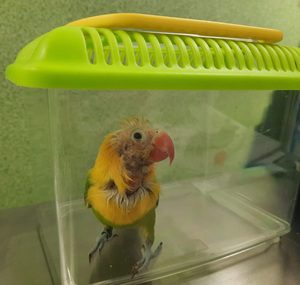
Bigger birds are best transported in a pet carrier – like those for cats or rabbits. Another option is an escape proof box. It’s important that there are no metal bars on which the bird can injure itself. Please make a picture of the cage bottom, so urine and feces can be examined.
Reptiles need to be kept warm during transport. This can be achieved by keeping them on top of bottles filled with warm water, in a styrofoam wrapped box or on an electric heat mat. Too prevent heat loss, turtles (except for certain species) should not be transported in water. Please make pictures of the aquarium/terrarium, so husbandry can be judges.
Most rabbits and rodents can be transported easily in a carrier or escape proof box. If they live with a bonded partner animal, please bring them in together, this will likely reduce stress.
Can my pet eat and drink before anesthesia/surgery?
Yes! Both water and food should be available at all times, even prior to surgery. If rabbits and rodents do not eat continuously there peristaltic will slow down, causing a build up of gas in their GI-tract.
Beside the build-up of gasses most small exotic pets have a very fast metabolism and withholding food will cause a drop in blood glucose, which can lead to shock.
In a few species (depending on the type of surgery) food should be withheld maximum 2 hours prior to surgery. If this is the case with your pet, you will be notified.
I found an injured wild animal. What should I do?
Before you try to catch it, touch it or take it to a vet, please call The Wild Animals Foundation. Some wild animals will bite and may transmit disease and should be handled by professionals only. Other wild animals – specially young- should not be handled at all. They are best left where they are, the parents are either near by or will come back as soon as the ‘coast is clear’.
If you decide to take it, use a towel to cover it’s face (whole body), gently lift it up and put it in a carton box (with holes for air). Do not feed the animal. Bring it to a vet as soon as possible.
How long will my exotic pet live?
This list includes the average life expectancy of most commonly owned exotic pets.
Rabbits 10-12 years
Guinea pig 7-8 years
Chinchillas 14 years (22 years in literature)
Degus 5-9 years
Hamsters 2-3 years (depending on the species)
Rats 2-3 years
Mice 1-2 years
Gerbils 4-5 years
African pygmy hedgehogs 4-7 years
Red ear sliders 20-40 years
Green Iguanas 15-20 years
Leopard Geckos 11-14 years
Bearded dragons 10-15 years
Boas 20-40 years
Pythons 30 years
Corn snakes 20 years
Budgies 15-20 years
Lovebirds 15-25 years
Cockatiels 15-25 years
Canaries 10-15 years
Alexandrine parakeets 20-30 years
African grey parrots 45-60 years
Amazon parrots 40-70 years
Macaws 60-80 years
African giant snails 10-15 years
Tarantulas 10-30 years
Scorpions 2-6 years
Gold fish 10-15 years
Betta fish 3-5 years
Contact Me

Call me


Send me a Message
